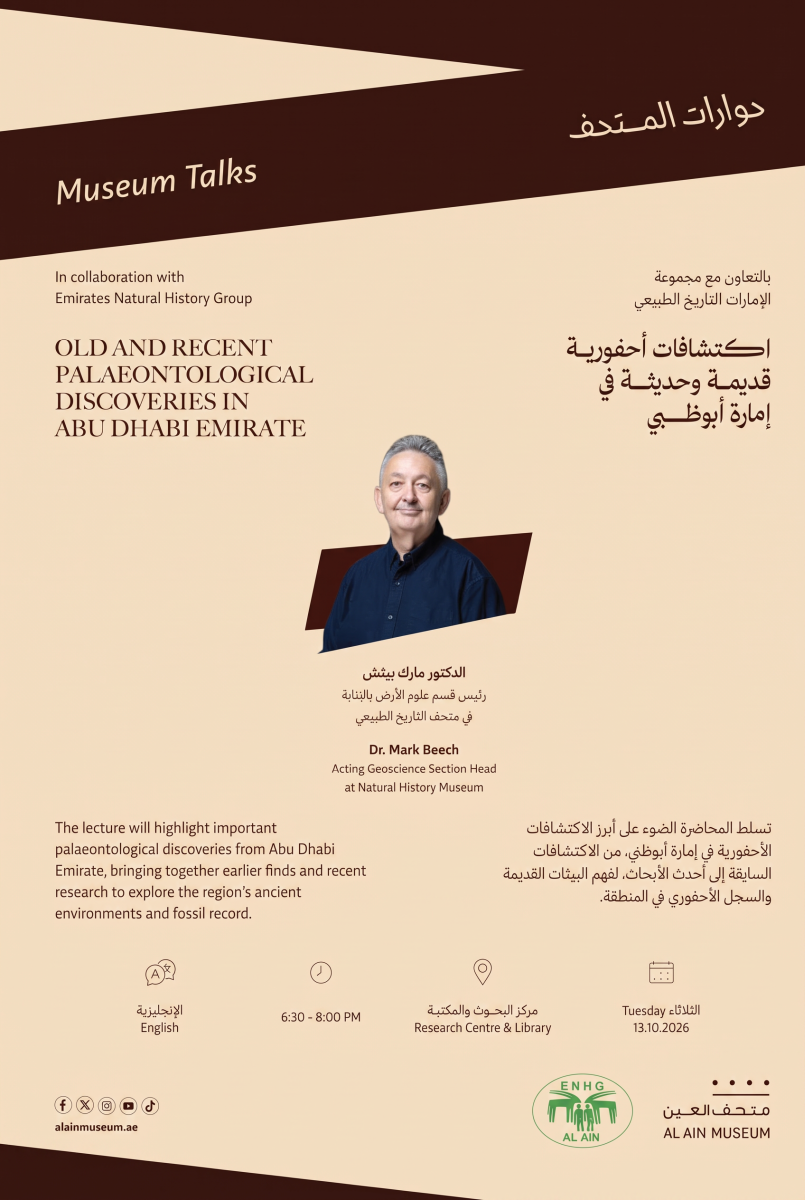
I am giving a talk on “Old and Recent Palaeontological Discoveries in Abu Dhabi Emirate” for the Al Ain branch of the Emirates Natural History Group. This will be hosted at the Al Ain Museum in Al Ain on Tuesday 13th October 2026, from 6:30 – 8:00 PM.
Enter by the Staff Entrance at Al Ain Museum. Parking available outside.
Google maps location: https://maps.app.goo.gl/TJjN2MA72QFb53Hm7
Abstract:
Abu Dhabi emirate is renowned for its exceptional palaeontological heritage, offering a remarkable window into the region’s deep past. Fossil discoveries from the Cretaceous, Eocene, and Miocene eras have revealed the emirate’s dynamic ancient environments. In the Al Ain region, Cretaceous marine deposits record the presence of ancient reefs, while Eocene strata contain evidence of diverse marine life, including gastropods, bivalves, echinoids, nummulites, and sharks. The Miocene formations, particularly within the Baynunah Formation in the Al Dhafra region of Abu Dhabi, are internationally significant, yielding fossils of elephants, crocodiles, hippos, turtles, and a variety of other also now extinct mammals, birds, fishes, and mollusca, reflecting a once-lush savannah, wooded and riverine landscape. Recent discoveries further enrich this narrative. Together, these finds demonstrate Abu Dhabi’s unique role in understanding both the geological evolution and history of the Arabian Peninsula, bridging natural heritage across millions of years.
Speaker:
Dr Mark Jonathan Beech (Acting Geoscience Section Head, Curatorial Department, Natural History Museum Abu Dhabi)
Biography:
Dr Beech is currently Acting Geoscience Section Head in the Curatorial Department at the Natural History Museum Abu Dhabi (NHMAD). His research interests include the study of Late Miocene vertebrate fossils from Abu Dhabi, and the archaeozoological analysis of fauna from prehistoric coastal sites in Arabia. He has published extensively on the palaeontology, archaeology and natural history of Abu Dhabi, having written 14 books and more than 170 papers. Dr Mark Jonathan Beech has a Bachelor of Sciences honours degree in Archaeology from the Institute of Archaeology, University College London (1982-1985), a master’s degree in environmental archaeology from the Department of Archaeology, University of Sheffield (1986-1987), and a Phd in archaeology from the Department of Archaeology, University of York, UK (1998-2001). Dr Beech has been involved in palaeontological and archaeological research in the UAE for the past 32 years, working for the Abu Dhabi Islands Archaeological Survey (1994-2006), Abu Dhabi Authority for Culture and Heritage (2006-2012), Abu Dhabi Tourism and Culture Authority (2012-2017) and for the Department of Culture and Tourism (2018-2024).
Agenda / Details:
This lecture is a joint session between the Al Ain Museum Heritage, History and Archaeology Lecture Series and the Emirate Natural History Group – Al Ain branch. The lecture will be open to both Emirates Natural History Group members and the public.