Celebrate International Museum Day at Natural History Museum Abu Dhabi (16 May 2026)

Come and celebrate International Museum Day at Natural History Museum Abu Dhabi. Free entry to the museum on Saturday 16th, Sunday 17th and Monday 18th May 2026.

Explore the wonders of the natural world through hands-on science and creative workshops.  See: This International Museum Day – One planet, many stories. You can register here.

Meet the Palaeontologist

Visit the PalaeoLab and meet real palaeontologists who work in the Natural History Museum Abu Dhabi. The team includes: Dr Mark Jonathan Beech, Dr Luca Bellucci, Dr Caroline Malem, Shamma Alhammadi, Mariam Alhassani and Avaneesh Khatavkar.

Date:  Monday 18 May, 2026
Time: 9 AM – 12 PM, 2-3 PM, 4-5 PM

Meet the Meteorite Expert

Meet the Meteorite expert from the Natural History Museum Abu Dhabi in the Story of Earth Gallery, Dr Ludovic Ferrière  (Curator – Geoscience).

Date: Saturday 17 May, 2026
Time:  11 AM to 1 PM, 2-4 PM, and 5-7 PM

Meet the Entomologist

Meet the Entomology expert from the Natural History Museum Abu Dhabi in the Life Sciences Lab, Dr Brigitte Howarth (Curator – Bioscience).

Date: Monday 18 May, 2026
Time:  10-11 AM, 1-2 PM, 3-4PM

Specimen Handling Workshop

Go behind the scenes with the collections team to discover how museum specimens are handled, preserved, and prepared. This rare insight reveals the careful processes that protect and present scientific collections.

Date: Monday 18 May, 2026
Time: 6 PM

Build a Mini Exhibit

Step into the role of a curator and create your own miniature exhibition. Participants select specimens, design displays, and learn how museums tell stories through objects and classification.

Date: Monday 18 May, 2026
Time: 3 PM, 5 PM, 6 PM

Needle Felting

Date: Monday 18 May, 2026
Time: Drop in

Sun Printing Activity

Harness the power of sunlight to create beautiful, one-of-a-kind prints using natural materials. This creative activity introduces participants to the science of light while producing striking visual patterns.

Date: Saturday 16 – Sunday 17 May, 2026
Time: 12 PM, 2 PM, 5 PM

Light Lab: Colour & Shadow

Step into a world of colour and light as participants experiment with transparent materials to create layered visual effects. By observing how colours overlap and interact, children gain a playful introduction to light behaviour and perception.

Date: Saturday 16 – Sunday 17 May, 2026
Time: 11 AM, 1 PM, 4 PM

Constellation Light Lab

Explore the night sky through a creative, hands-on activity that brings constellations to life. Participants create their own constellation viewers and discover how light travels, while learning how humans have long mapped patterns in the stars.

Date: Saturday 16 – Sunday 17 May, 2026
Time: 11 AM, 1 PM, 4 PM

Shadow Safari

Turn light into storytelling in this interactive shadow play experience. Using hands and simple shapes, participants create animal silhouettes and perform behind a lit screen, blending science with creativity and performance.

Date:  Saturday 16 – Sunday 17 May, 2026
Time: 12 PM – 6 PM

Wiggly Creatures Workshop

Get imaginative with craft materials to create moving, expressive creatures inspired by the natural world. This playful session explores how structure and movement help animals survive and interact with their environments.

Date:  Saturday 16 May, 2026


This International Museum Day, Abu Dhabi Culture invites you to a special three-day celebration with free entry to all Abu Dhabi museums and cultural institutions, alongside hands-on workshops, live performances, and guided tours across the emirate.

Under this year’s global theme “Museums Uniting a Divided World“, discover how Abu Dhabi’s museums act as bridges across cultures, fostering dialogue, understanding, and connection within and between communities worldwide.

From Saadiyat Cultural District and Al Ain Cultural Sites to the shores of Delma Island— there’s never been a better time to explore Abu Dhabi.

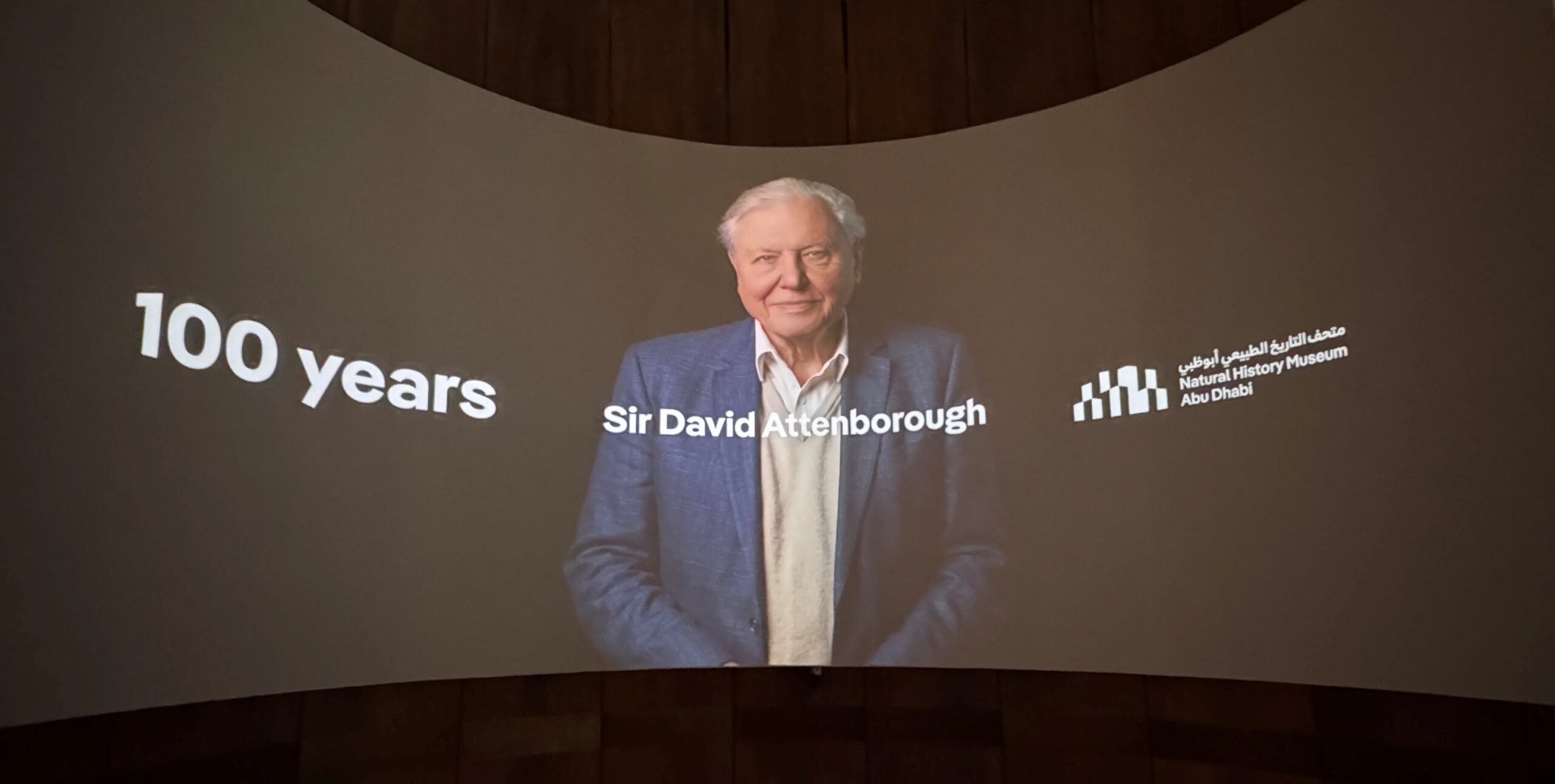
We celebrate Sir David Attenborough’s 100th Birthday at Natural History Museum Abu Dhabi (8 May 2026)

On Friday 8th May we celebrated Sir David Attenborough’s 100th Birthday at Natural History Museum Abu Dhabi. Sir David Attenborough was born on the 8th May 1926. A special film highlighting segments from four of his internationally known nature documentary programmes was shown in the Library of Nature inside the Our World  gallery at the Natural History Museum Abu Dhabi. This included:  “Introduction” (my boyhood journey from the Charnwood Forest), “The Worlds’ First Creatures”, “The magic of fungi”, “The missing link between dinosaurs and birds”, and “How reptiles adapted to survive”. The film was produced by Atlantic Studios in partnership with Natural History Museum Abu Dhabi.

The film transcript was as follows:

Introduction:
A journey that began for me near my boyhood home of Charnwood Forest has taken me around the world and through 600 million years of evolutionary history.

The world’s first creatures:
Single-celled life dominated the planet for billions of years, till a global ice age triggered the emergence of the first animals. Many animal groups lasted millions of years, but eventually their time ran out and they disappeared.

The magic of fungi:
As the leaves fall, a new world reveals itself from beneath the soil. Fungi. Fungi can’t photosynthesize, because, unlike plants, they have no chlorophyl. In fact, they are more closely related to animals and are made of chitin. The material insects use for their skeletons. They produce powerful chemicals that enable them to break down about 90% of all organic matter, including leaves and wood. In doing this, they release the nutrients into the soil that plants need to fuel their new growth in the spring.  So fungi are essential links in the cycle of life.

The missing link between dinosaurs and birds:
Could this strange looking dinosaur with feathers all over it actually fly?  Some people think that those feathers on its hind legs would have made it rather difficult for it to walk around on the ground, and that it would have been more at home climbing. But those aerodynamically shaped feathers certainly suggest its arms were being used as wings.  This four-wing dinosaur must have been a really extraordinary animal. Its front wings were broad enough to enable it to glide, and its muscles on the chest were sufficiently strong to enable it to flap. Every now and then, and help on its way. Now clearly these dinosaurs were on their way to join the pterosaurs in the sky.

How reptiles adapted to survive:
In their ancestral rainforest habitat, iguanas are vegetarians. Here, they browse on juicy leaves. But there, at first appeared in the Galapagos, could find no such things,. So these iguanas to survive had to eat the only kind of leaf that was available. Seaweed. And to get the best of that, they had to something even more radical. They had to swim.  They even learned to dive.  They acquired the ability to hold their breath for up to an hour, so that they could swim down toa  depth of 20m.  Their claws strengthened so they could cling to the rocks on the seabed. And under the water,  they found an endless supply of seaweed, which grew in abundance in the nutrient rich currents that flow around the islands.

For more information about Sir David Attenborough and his contribution to improving our understanding of the natural world of our planet, please visit the following links:

David Attenborough – Wikipedia

100 years of Sir David Attenborough – BBC (YouTube)