7th International Palaeontology Congress (IPC7) – Cape Town, South Africa (30 November – 3 December 2026)


I am taking part in the 7th International Palaeontological Congress (IPC7), due to be held in the vibrant and beautiful city of Cape Town, South Africa, from 30 November – 3 December 2026.

I will be the presenting author making an oral presentation in the Congress Session Theme 21: Communicating paleosciences.  The paper is as follows:

Communicating palaeosciences at the Natural History Museum Abu Dhabi
Mark Jonathan Beech1*, Luca Bellucci1, Shamma Alhammadi1, Mariam Alhassani1 & Phillip Manning1

1Natural History Museum Abu Dhabi, Abu Dhabi, United Arab Emirates

*e-mail: mbeech@nhmad.ae

Abstract:
The Natural History Museum Abu Dhabi (NHMAD) is dedicated to advancing public understanding of natural history, but with a major focus on geoscience and palaeontology through innovative exhibitions, education, and research programs. The museum aims to bridge the gap between research and community awareness by showcasing global geological and fossil heritage but with a focus on UAE sites and specimens Through immersive exhibitions, interactive displays, and educational programs tailored to diverse audiences, the museum brings to life the story of Earth’s history and the evolution of life. A central goal for the museum is to facilitate palaeosciences to be more accessible and relevant to the wider public. The approach of the museum team is to integrate cutting-edge technologies, such as state-of-the-art X-ray imaging, to foster curiosity and facilitate hands-on learning experiences based on objects from the collections. The NHMAD has curated an exceptional gallery dedicated to Late Miocene fossils discovered in the Emirate of Abu Dhabi, United Arab Emirates, showcasing fossils that date back approximately seven million years. The exhibition offers a unique opportunity to resurrect a long-extinct world and bring both flora and fauna from the Late Miocene back to life. Key partnerships with schools, universities, and international research institutions further enhance the museum’s education and outreach program, supporting the development of scientific literacy and inspiring future generations. Special attention is given to engaging Emirati youth and families, aligning with national strategies to promote knowledge-based growth and cultural relevance of the natural world. Ultimately, the NHMAD serves as an intercultural platform for dialogue between scientists and the 200+ nationalities that live or visit Abu Dhabi. Through the democratization and access to natural history and the palaeosciences, the museum not only enriches local and regional cultural landscapes but also contributes to global conversations on Earth’s past, present, and future.

Key words:
natural history, museum, UAE, communication, palaeoscience


Our Natural History Museum Abu Dhabi team will also be co-authoring a second paper in the Congress Session Theme 22: Cenozoic vertebrates of Africa. The paper is as follows:

A new large civet from the Late Miocene of Abu Dhabi highlights the biogeographic crossroads between Asia and Africa

Alberto Valenciano 1,2*, Mark Jonathan Beech3 & Luca Bellucci3

1 Departamento de Geodinámica, Estratigrafía y Paleontología, Facultad de Ciencias Geológicas, Universidad Complutense de Madrid, Madrid, Spain

2 Research and Exhibitions, Iziko Museums of South Africa, Cape Town, South Africa

3 Natural History Museum Abu Dhabi, Abu Dhabi, United Arab Emirates

*e-mail: albvalen@ucm.es

Abstract:
The Baynunah Formation of western Abu Dhabi preserves one of the most important Late Miocene terrestrial vertebrate records in the Arabian Peninsula. In February 2026, a right hemimandible of a large viverrid (NHMAD2026.00059.1) was discovered at Shuwaihat 2 (c. 7 Ma), representing the first record of the family Viverridae from the Arabian Peninsula. This discovery provides a unique opportunity to investigate the evolutionary history of large viverrines and to assess the role of the Middle East in Late Miocene faunal exchanges between Asia, Africa and Europe. Preliminary morphological and biometric analyses indicate that the specimen differs from the extant African civet, Civettictis civetta, in possessing a more elongated p4 and a more slender m1. It is also distinct from the living Asian civets Viverra zibetha and Viverra tangalunga, the Late Miocene African species Sahelictis korei from Chad, and several Asian Miocene species of Visnhuictis from the Siwaliks and China (e.g. V. yuanmoensis, V. (?) chienjensis and V. hasnoti). In contrast, the Abu Dhabi specimen exhibits notable similarities to the early Pliocene Civettictis vulpidens from Langebaanweg (South Africa) as well as to the Eurasian giant civets Megaviverra carpathorum and Megaviverra peii. These affinities suggest that the Arabian Peninsula may have functioned as an important dispersal corridor for large viverrines between Asia and Africa during the end of the Late Miocene. Ongoing morphological, phylogenetic and palaeobiogeographic analyses will further test these evolutionary and biogeographic hypotheses.

Key words:
Carnivora, Viverridae, Miocene, Paleobiogeography

Homo erectus Conference, Tbilisi, Georgia (10-13 September 2026)

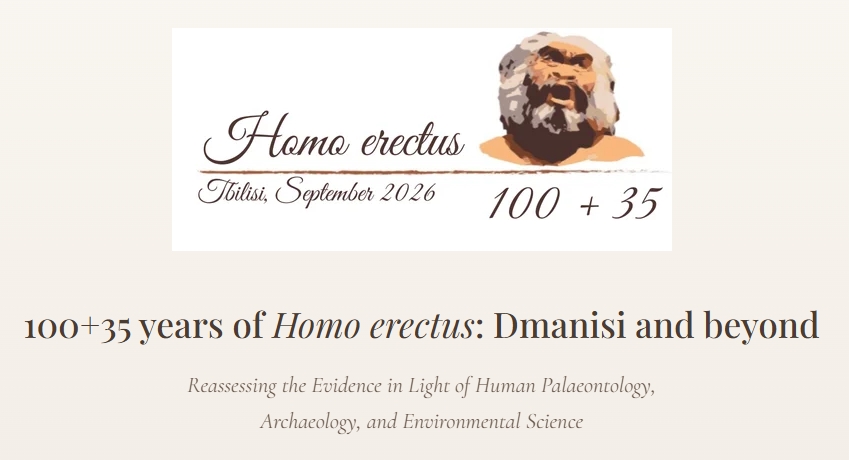
I will be attending the Homo erectus 2026 conference due to be held at the lecture hall of the Georgian National Museum in Tbilisi. The conference is entitled “100 +35 years of Homo erectus: Dmanisi and beyond. – Reassessing the Evidence in Light of Human Palaeontology, Archaeology, and Environmental Science“.

In 1991, exactly 100 years after the 1891 discovery of Pithecanthropus erectus in Java, the International Senckenberg Conference was held in Frankfurt to review a century of Homo erectus research. At this centennial meeting, the first hominin find from Dmanisi made its debut on the international scientific stage. What followed was an extraordinary story of discovery in the southern Caucasus: over the next 35 years, systematic excavations revealed five remarkably well-preserved skulls, fundamentally reshaping perspectives on early human evolution.

By 2016, a quarter century later, the “Homo erectus enigma” remained one of the most intriguing questions in paleoanthropology, inspiring another major international conference in Tbilisi. Since then, the Dmanisi hominins have continued to challenge the scientific community and refine our understanding of early Homo evolution. With each new analysis, they provide not only answers but also raise new questions, highlighting how much of our evolutionary history remains unresolved.

Now, after 135 years of the first discovery of Homo erectus, and a decade after the last major international conference devoted to this topic, these questions remain as vital as ever. With new evidence accumulating, the time is ripe to once again reassess what we know — and what we have yet to uncover — about one of the most significant species in human evolution.

The conference includes an excursion to the prehistoric sites of Dmanisi (the archaeological site where the oldest hominin fossils outside Africa were discovered) and Orozmani (prehistoric site with significant archaeological findings), as well as Bolnisi Museum (a regional museum showcasing local history and archaeology).