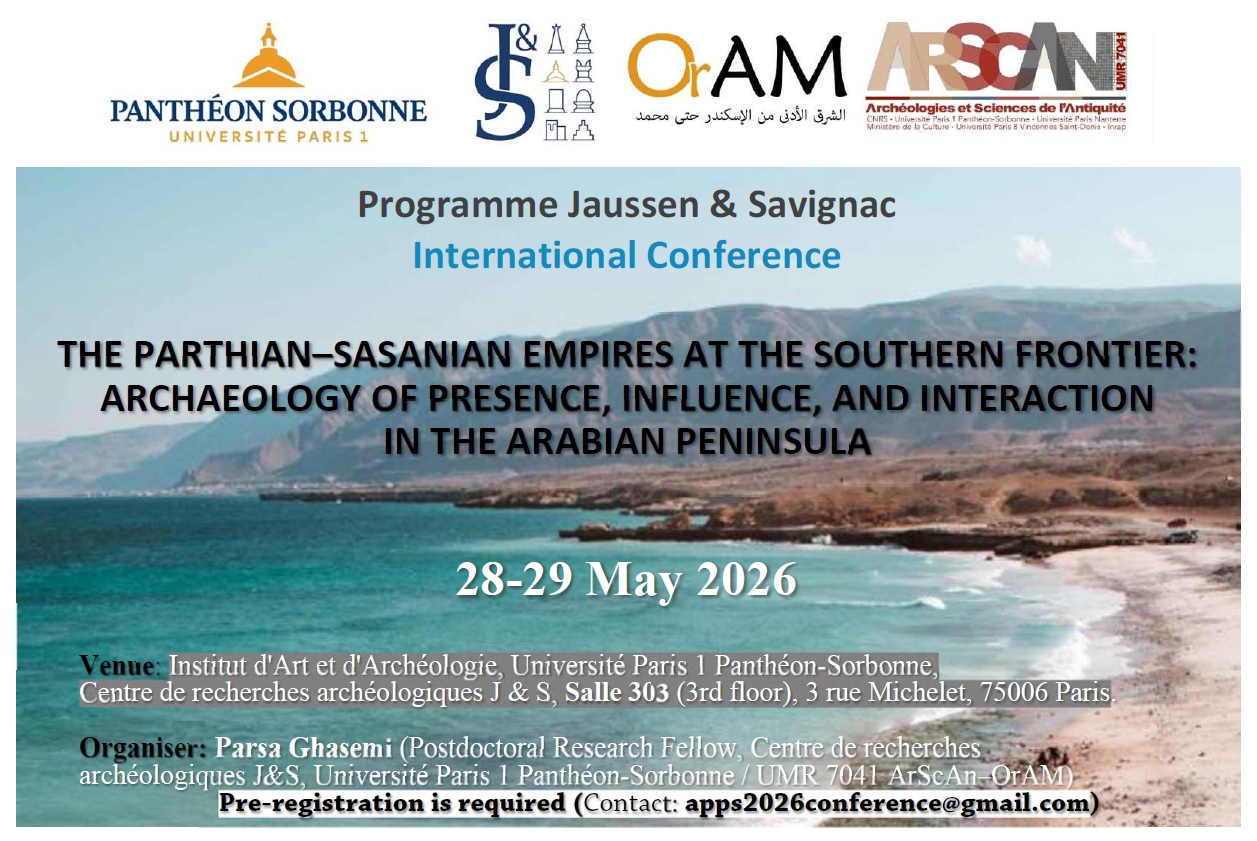
I was a co-author on the following paper which was presented at the
Programme Jaussen & Savignac International Conference:
THE PARTHIAN–SASANIAN EMPIRES AT THE SOUTHERN FRONTIER: ARCHAEOLOGY OF PRESENCE, INFLUENCE, AND INTERACTION IN THE ARABIAN PENINSULA
held from 28-29 May 2026
Venue: Institut d’Art et d’Archéologie, Université Paris 1 Panthéon-Sorbonne, Centre de recherches archéologiques J & S, Salle 303 (3rd floor), 3 rue Michelet, 75006 Paris.
Organiser: Parsa Ghasemi (Postdoctoral Research Fellow, Centre de recherches archéologiques J&S, Université Paris 1 Panthéon-Sorbonne / UMR 7041 ArScAn–OrAM)
Here is the abstract of the paper presented at the conference:
Animal remains from Late Pre-Islamic, Parthian–Sasanian contexts in the Arabian Peninsula. Local or Global?
Marjan Mashkour (1)*, Karyne Debue (1), Azadeh Mohaseb (1), Homa Fathi (2), Mark Jonathan Beech (3), Wim Van Neer (4), Michel Mouton (5) and Seth Priestmann (6)
1 – UMR 7209 (BioArch)- BioArchéologie, Interactions Sociétés Environnements CNRS (Centre national de Recherche Scientifique) & MNHN (Muséum national d’Histoire naturelle), Paris, France.
2 – Bioarchaoleogy Laboratory, Central Laboratory, University of Tehran, Iran.
3 – Natural History Museum Abu Dhabi- United Arab Emirates.
4 – Royal Belgian Institute of Natural Sciences, Brussels; KU Leuven, Belgium.
5 – Centre Français de Recherche de la Péninsule Arabique (CEFREPA)- CNRS, France
6 – Institute for the Study of Ancient Cultures, University of Chicago, USA.
*Corresponding author
In recent decades, bioarchaeological investigations have greatly improved our understanding of how mobile and sedentary communities in the Arabian Peninsula utilised natural resources. This presentation focuses on archaeozoological assemblages dating to the Parthian (c. 247 BCE–224 CE) and Sasanian (224–651 CE) periods, which were found in the United Arab Emirates (UAE) and Oman from various contexts.
Mleiha, (Sharjah in the UAE), is a significant site from the Late Pre-Islamic Arabian Kingdom, which emerged by the 3rd century BCE. Excavations in the necropolis revealed funerary practices involving camels and horses. During the final occupation levels (2nd and early 3rd century CE) in three areas excavated by the French Archaeological mission in Sharjah, mammalian and ichthyofaunal remains were found, composed of predominantly domestic bovids, as well as evidence of the hunting of gazelle and oryx for the terrestrial animals. The fort (CW) and the fortified residence (H) were occupied by the ruling elite, and some dwellings were excavated in proximity to the fort (DA).
Ed-Dur (Umm al-Quwain, UAE) was a key port on the Persian Gulf that linked trade routes between Mesopotamia, the Indian subcontinent, and the eastern Mediterranean. The extensive faunal remains, dating to the 2nd–4th century CE, show a reliance on fishing and sheep/goat herding, as well as stable terrestrial hunting, and potentially the over-exploitation of marine resources. Dog and sheep/goat remains also appear in ritual contexts.
On Sir Bani Yas Island (Abu Dhabi, UAE), archaeologists recovered fish remains and sparse mammalian remains within the Christian monastery. Similar material has recently been discovered in Umm Al-Quwain.
Finally, excavations at the fort of Fulayj in NE Oman indicate occupation in the late Sasanian and early Islamic periods. The fort’s occupants depended heavily on sheep, goats, cattle, and marine resources, and donkeys were used for transport.
While investigating the subsistence of various communities and the exploitation of animals in coastal and inland sites in NE Arabia, we will gain a broader perspective by making comparisons with contemporary Parthian and Sasanian sites in neighbouring Iran.